

Sustaining business growth and organizational resilience requires continuous, effective leadership—a crucial factor often challenged by market volatility and rapid technological change. Succession planning—the intentional process of identifying and developing internal talent to fill key leadership roles—is the safety net that ensures organizational stability. While the entire C-suite must be invested, the Human Resources department serves as the vital engine that designs, manages, and executes this complex, long-term strategy.
HR’s role goes beyond maintaining an org chart; it strategically aligns talent development with the company’s future business goals. Here are the core ways HR assists with succession planning.
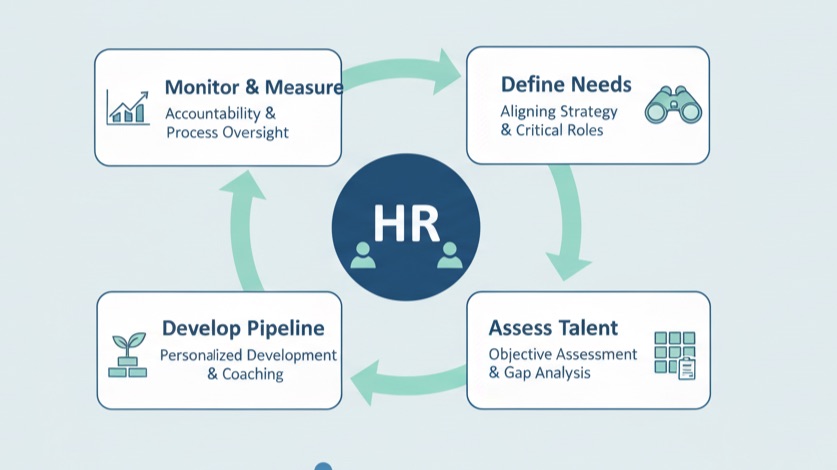
Defining Future-Ready Critical Roles
Succession planning starts not with people, but with positions. HR partners with senior leadership to look three, five, and even ten years ahead to anticipate organizational needs.
-
Identifying Critical Roles: HR helps pinpoint the roles (beyond the executive level) that are essential for business continuity and strategy. This includes specialized, highly technical positions or roles holding unique institutional knowledge.
-
Developing Competency Models: HR is responsible for defining the succession criteria for these critical roles. This involves creating detailed profiles that outline not only the required technical skills but also the future-ready leadership competencies, behavioral traits, and experiences necessary for success in a dynamically changing market.
Objective Talent Assessment and Gap Analysis
Once the target roles are defined, HR shifts focus to the current workforce to find high-potential (HiPo) employees. The goal is to make this process objective and fair.
-
Utilizing Assessment Tools: HR implements objective assessment tools like the 9-Box Grid, which is the gold standard for visualizing talent. This grid measures current performance (horizontal axis) against future potential (vertical axis), quickly identifying high-potential (HiPo) employees (typically in the top-right box) as well as those needing immediate intervention. The results, combined with 360-degree feedback and structured interviews, ensure a data-driven approach that minimizes unconscious bias in the selection process.
-
Conducting Gap Analysis: HR analyzes the difference between the competencies required for the future role and the current capabilities of the potential successor. This “gap” forms the foundation for the individual’s personalized development plan.
-
Promoting Inclusion: A key modern HR function is ensuring diversity and inclusion in the successor pipeline. HR actively seeks candidates from varied backgrounds and departments to build a stronger, more resilient, and equitable leadership bench.
Designing and Implementing Development Pathways
Developing a successor often takes years, and HR is the architect of these tailored growth journeys. They facilitate the necessary resources and structure to close those identified skill gaps.
-
Personalized Development Plans (IDPs): These are the blueprints for growth. HR works with managers and HiPo employees to create detailed Individual Development Plans (IDPs). A typical IDP outlines specific skill gaps, links them directly to the required future competencies, and mandates a balanced mix of training methods, including formal education, on-the-job experience, and reflective assignments. IDPs ensure that development is intentional and measurable, moving candidates methodically toward readiness.
-
Mentorship and Coaching: HR establishes formal, structured mentorship programs, matching potential leaders with seasoned executives. They also coordinate executive coaching to help candidates hone soft skills, like strategic thinking and conflict resolution.
-
Experiential Learning: The most valuable development often happens on the job. HR coordinates stretch assignments, cross-functional rotations, and leadership projects that challenge successors and expose them to various areas of the business, preparing them for the holistic demands of leadership.
Driving Accountability and Process Oversight
Succession planning is a continuous process, not a one-time event. HR is responsible for establishing the framework, managing the timeline, and keeping the plan current.
-
Facilitation and Reporting: HR facilitates the critical talent review meetings with senior leadership, ensuring consistency in assessment and decision-making. They track the progress of successors, measuring their readiness for transition.
-
Transparency and Communication: HR manages the communication strategy, promoting transparency about the process (if not always the exact names of successors). This openness boosts employee engagement by demonstrating a clear path for career growth and organizational commitment to internal promotion.
-
Evaluation and Metrics: HR defines the Key Performance Indicators (KPIs) for the succession plan itself. Metrics might include the percentage of critical roles filled internally, time-to-fill for key positions, and the turnover rate among high-potential employees. These metrics ensure the plan is effective and aligned with business results.
HR as the Steward of Organizational Resilience
The HR department is the steward of organizational resilience. By strategically identifying future needs, objectively assessing current talent, designing targeted development programs, and managing the ongoing process, HR ensures that a company is never caught off guard by an executive departure or a sudden market shift. Succession planning is arguably HR’s most powerful tool for ensuring long-term business continuity and fostering a dynamic, motivated culture of internal growth.
To begin designing or refining your strategic succession planning process, contact Cushion for expert guidance and tailored solutions.