


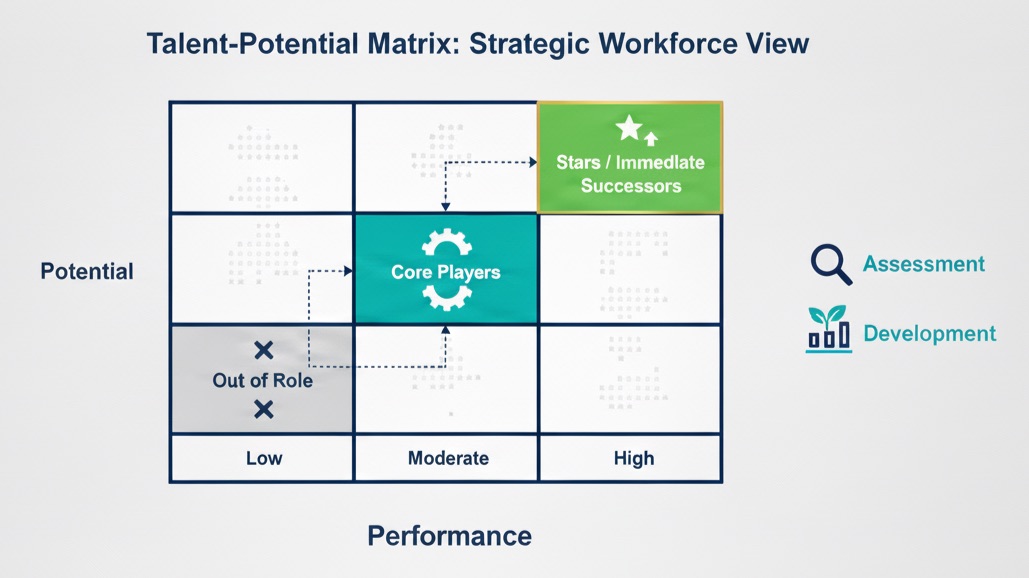
Succession planning is fundamentally about identifying and nurturing the right talent for the right future roles. The sheer volume of data—from performance reviews and project feedback to career aspirations—can make this process overwhelming. This is where the 9-Box Grid becomes indispensable, transforming qualitative assessments into a clear, actionable visual framework.
Often considered the gold standard in talent review, the 9-Box Grid provides a common language for leaders to discuss employee capabilities and potential. It allows HR to move beyond subjective opinions and anchor succession decisions in objective data.
What is the 9-Box Grid?
The 9-Box Grid is a talent management matrix that evaluates every employee across two critical dimensions, dividing the workforce into nine distinct categories.
-
Performance (Horizontal Axis): Measures the employee’s current effectiveness, typically based on recent performance reviews and achievement of goals (Low, Moderate, High).
-
Potential (Vertical Axis): Measures the employee’s capacity for growth, ambition, and ability to assume increased responsibility in the future (Low, Moderate, High).
By plotting every employee onto one of these nine squares, organizations can quickly identify where development efforts should be focused.
Decoding the 9 Boxes: Talent Strategy in Action
Each box suggests a clear, tailored strategy for development, retention, or risk management:
The High-Potential Zone (Top Right)
This zone includes “High Performance, High Potential” employees, often called “Stars” (Box 9).
- Succession Strategy: These individuals are your prime candidates for critical, near-term succession needs. The strategy here is rapid development and retention. HR should expose them to executive coaching, cross-functional stretch assignments, and specialized leadership training to prepare them to step into key roles within 1 to 3 years. They are your immediate leadership pipeline.
The Core Zone (Middle)
This zone includes “Moderate Performance, Moderate Potential” (Box 5) and “High Performance, Moderate Potential” (Box 6), often called “Core Players” or “Solid Contributors.”
- Succession Strategy: These employees are crucial for day-to-day operations. The strategy is retention and focused development. HR should identify the specific skills they need to move diagonally (e.g., from Box 6 to 9) and use Individual Development Plans (IDPs) to target those few key growth areas. They represent the long-term, stable pipeline.
The Low-Risk/Low-Potential Zone (Bottom Left)
This zone includes “Low Performance, Low Potential” (Box 1).
- Succession Strategy: While not typical candidates for upward succession, HR must address employees in this zone with specific performance improvement plans. If performance does not improve, the strategy shifts to managing transition or finding a role better suited to their current skill set.
Applying the Grid to Succession Planning
HR utilizes the 9-Box Grid as a dynamic planning tool with these core actions:
-
Objective Candidate Identification: The grid removes subjectivity. Instead of relying on a leader’s “gut feeling,” the process highlights individuals consistently rated as “Stars” (High-High) and “High Potentials” (High Performance, Moderate Potential), creating a diverse, data-backed slate of successor candidates.
-
Resource Allocation: The grid directs resources where they matter most. HR ensures that the most expensive and intensive development programs (like executive coaching or specialized certifications) are reserved for employees in the high-potential zones, maximizing the return on development investment.
-
Risk Management: By visualizing who is in which box, HR can quickly identify “key person risk”. If a critical role is currently held by a “Star” but has no qualified successor in the top two boxes, HR knows immediately that external recruiting or accelerated internal development is needed to close that gap.
-
Informing IDPs: The grid serves as the starting point for Personalized Development Plans (IDPs). For example, an employee in the “High Performance, Low Potential” box may be an expert who needs motivation or exposure to strategic thinking to increase their potential rating. Their IDP will focus specifically on those missing components.
Conclusion
The 9-Box Grid is more than just a visual tool; it is the strategic blueprint for building a pipeline of prepared leaders. By fostering objective conversations and guiding targeted development, HR ensures the organization has the right people, with the right skills, ready to assume leadership roles when the time comes.
To implement a robust talent review process using the 9-Box Grid and integrate it seamlessly into your succession strategy, contact Cushion for expert guidance and tailored solutions.